Human-Machine Interaction Needs a Movement Vocabulary
Embodied AI and robotics need more than trajectories and coordinates; they need movement design that humans can understand and trust.
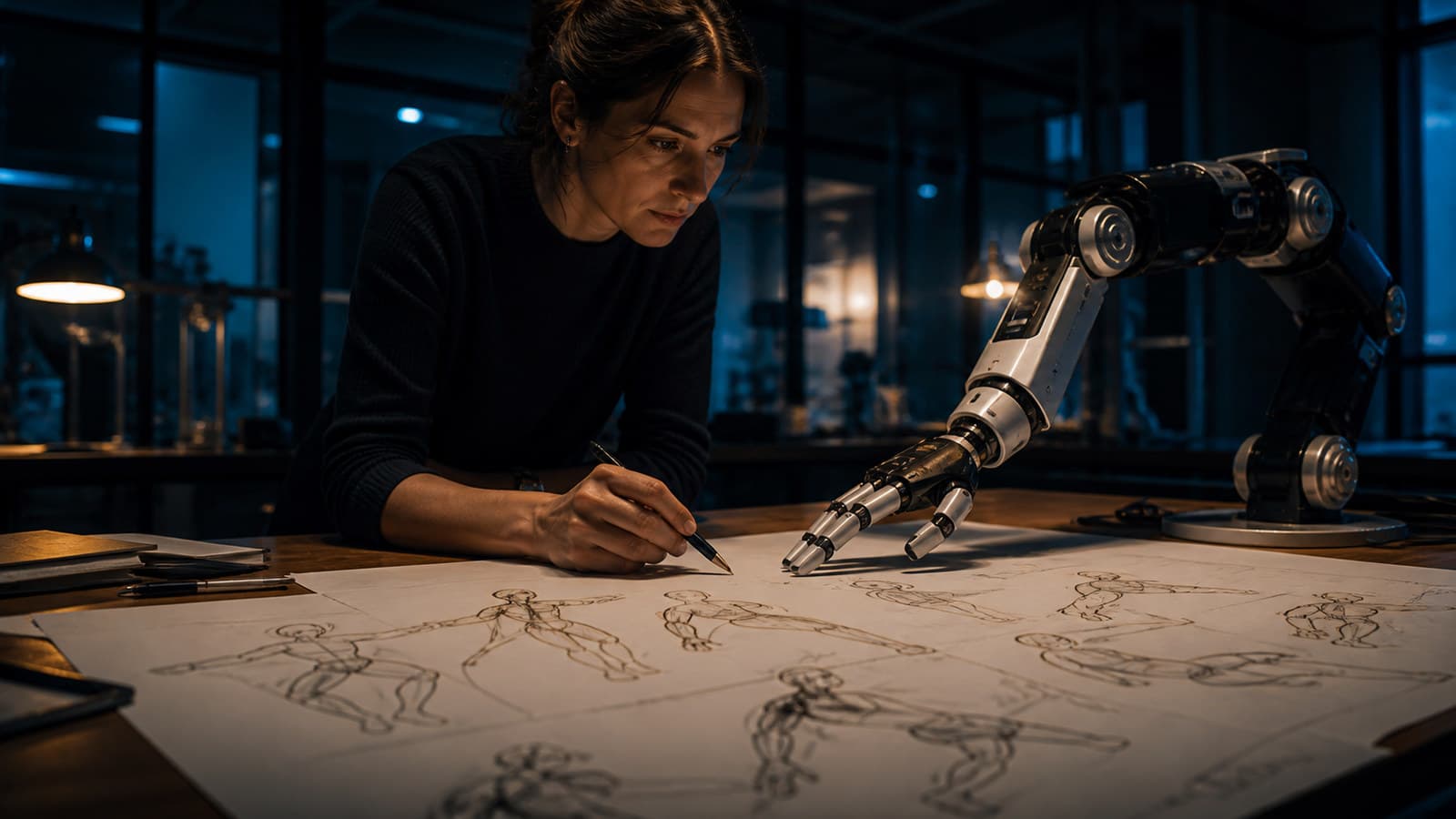
Human-Machine Interaction Needs a Movement Vocabulary
Most robotics and AI product teams describe movement in technical terms: position, velocity, acceleration, trajectory, joints, constraints, control policies, sensor feedback. These are essential, but they are not sufficient for human-machine interaction. Making Meaning with Machines by Amy LaViers and Catherine Maguire, based on its title, table of contents, and preface excerpt, argues for a richer vocabulary grounded in somatics, choreography, notation, and Laban/Bartenieff movement studies.
The product relevance is immediate. Machines increasingly move in human environments: collaborative robots, autonomous vehicles, warehouse robots, surgical systems, rehabilitation devices, drones, service robots, and embodied AI agents. Their motion is not merely mechanical. It is perceived, interpreted, and trusted or distrusted by people.
LaViers’ preface describes the limits of representing human movement as sequences of static poses or motion-capture coordinates. She initially tried to quantify movement quality with a small number of variables, but later recognized the richness of human motion and the limitations of purely quantitative models. This is a warning for product teams that treat movement data as self-explanatory.
The book’s BESST system offers a useful design lens: Body, Space, Time, Shape, and Effort. Product teams can translate these into practical questions. Body: which parts of the machine or human are moving, and how are they connected? Space: where does movement happen relative to people and objects? Time: what rhythm, speed, and sequencing are perceived? Shape: how does movement relate to the environment and to others? Effort: what quality does the motion communicate—direct, light, strong, hesitant, sudden, sustained?
This vocabulary can improve requirements, prototyping, user testing, and safety analysis. For example, a cobot may pass formal safety tests but still make workers uncomfortable if its motion is abrupt or illegible. An autonomous vehicle may stop correctly but fail to communicate intention to pedestrians. A healthcare robot may complete a task but feel impersonal or invasive because its timing and spatial approach are poorly designed.
The table of contents also highlights notation and symbolic representation. This matters because product teams need ways to discuss movement across disciplines. Engineers, designers, clinicians, dancers, and users cannot collaborate effectively if movement is described only as code or only as feeling. A shared notation can become a bridge.
At Ozycore, this suggests a productization principle: embodied AI requires embodied UX. Human-machine interaction should include movement audits, motion prototypes, qualitative observation, expert movement annotation, and user perception testing. Metrics should include not only task completion and collision avoidance, but also legibility, comfort, perceived intention, and contextual appropriateness.
The book also points toward better datasets. If motion clips are labeled only by coordinates, models learn geometry. If they are labeled with expert movement concepts, models may better support expressive and socially aware behavior.
The next wave of robotics will not be defined only by mechanical capability. It will be defined by whether machines can move in ways humans understand.