Multi-Agent Reinforcement Learning and the Architecture of Coordinated AI
Multi-agent AI requires architecture for interaction, rewards, evaluation and deployment because agents learn in environments shaped by other agents.
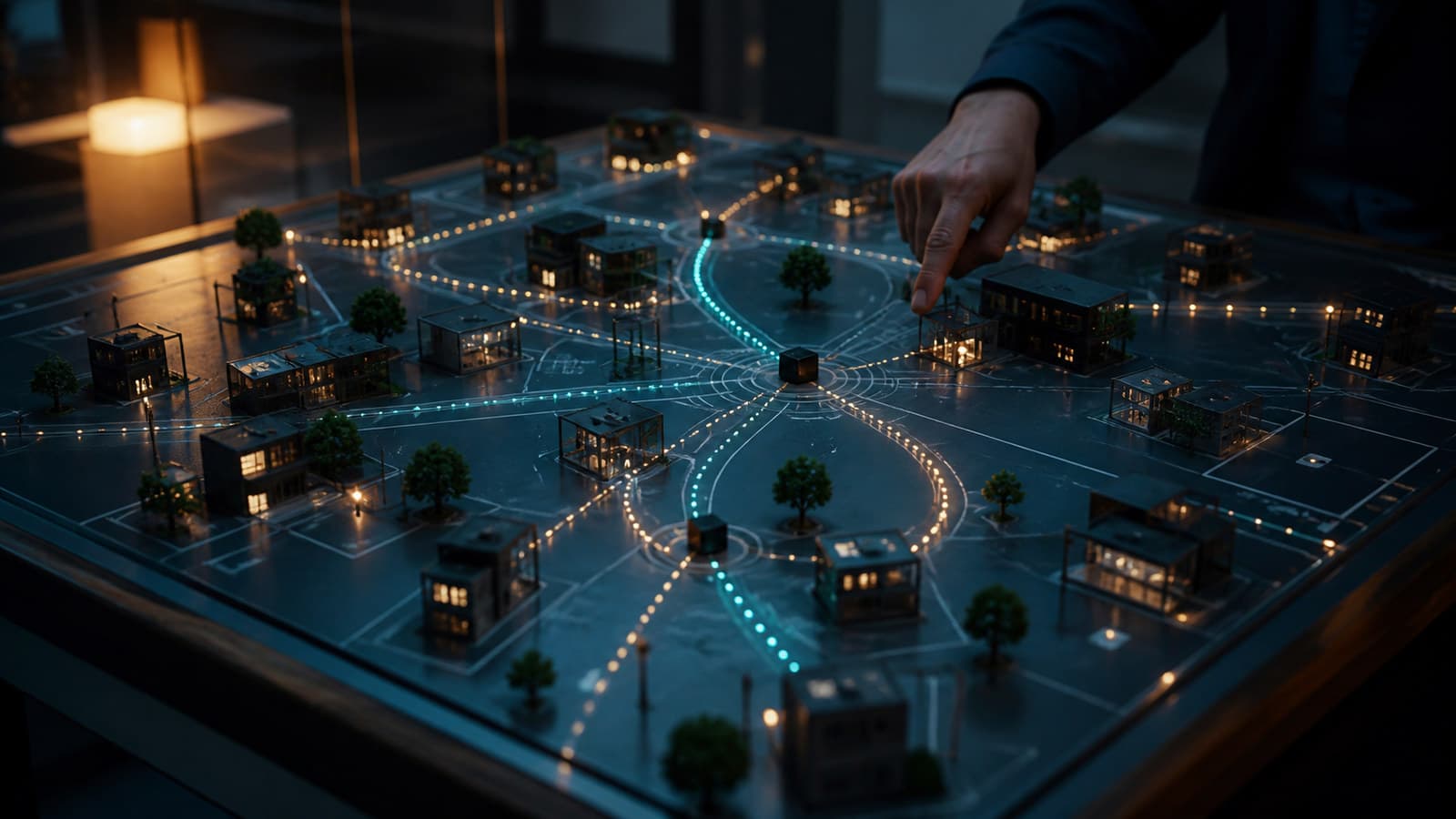
As AI systems become more autonomous, product teams will increasingly face multi-agent problems. A single model may be manageable. A network of learning agents that interact with each other is a different engineering challenge. Multi-Agent Reinforcement Learning: Foundations and Modern Approaches by Albrecht, Christianos, and Schäfer provides a structured foundation for this challenge.
Based on the excerpt and table of contents, the book builds from reinforcement learning fundamentals to game-theoretic models of interaction and then to modern deep multi-agent reinforcement learning. It covers Markov decision processes, value functions, dynamic programming, stochastic games, partially observable stochastic games, solution concepts such as minimax and Nash equilibrium, foundational MARL algorithms, deep RL, centralized training with decentralized execution, value decomposition, agent modeling, self-play, population-based training, and practical environments.
For AI productization, the key point is that multi-agent systems behave differently from single-agent systems. In single-agent RL, the environment can often be modeled as stationary. In MARL, the environment includes other learners. This creates non-stationarity. An agent’s policy changes the data distribution and reward landscape for other agents. This has direct implications for training stability, evaluation, and deployment.
The book’s listed challenges—non-stationarity, equilibrium selection, multi-agent credit assignment, and scaling—map well to engineering risks. Non-stationarity makes offline validation harder. Equilibrium selection raises the question of which stable behavior the system should converge to. Credit assignment affects learning when a global reward depends on many agents. Scaling creates computational and coordination challenges.
From a consulting perspective, MARL is relevant beyond robotics and games. It can inform logistics networks, supply-chain coordination, fleet management, dynamic pricing, industrial automation, autonomous mobility, and multi-agent software workflows. As companies deploy AI agents into operational processes, interactions between agents become a design concern.
A practical architecture question is whether to use centralized training, decentralized execution, or both. Centralized training can use global information during learning, which may improve coordination. Decentralized execution allows agents to operate locally, which may be necessary for latency, robustness, or privacy. The right choice depends on the product context.
Another design issue is evaluation. In multi-agent systems, testing one agent in isolation is often insufficient. Teams need scenario-based evaluation, adversarial cases, environment collections, and learning curves that reflect interaction dynamics. The book’s attention to environments such as multi-robot warehouses, StarCraft, Google Research Football, Hanabi, Overcooked, and PettingZoo-style collections indicates how important standardized environments are for experimentation.
For ozycore.de’s audience, the main lesson is that coordinated AI requires coordinated architecture. If agents are optimized independently, the system may produce unintended behavior. If rewards are poorly designed, agents may learn strategies that satisfy metrics but violate product goals. If training and execution modes are mismatched, deployment may fail.
MARL is not the answer to every automation problem. But it provides a language for systems where decisions interact. As AI agents become part of enterprise software, that language will become increasingly important.